Park Slope
Lifestyle & Vibe
Park Slope's physical and environmental identity is inextricably linked to Prospect Park, the 526-acre landscape architectural landmark designed by Frederick Law Olmsted and Calvert Vaux. The park forms the entire eastern border of the neighborhood, providing immediate access to the Long Meadow, the Ravine, and the LeFrak Center at Lakeside. The neighborhood is crowned to the north by Grand Army Plaza, featuring the monumental Soldiers' and Sailors' Arch as a dramatic civic gateway.
The public realm is highly activated through civic programming, notably the Fifth Avenue Open Streets initiative, which routinely closes designated blocks to vehicular traffic on Saturdays to create pedestrian plazas with outdoor dining and community marketplaces. Public transit is anchored by the F, G, and R subway lines across multiple stations—particularly the 4th Avenue-9th Street nexus—alongside the 2 and 3 trains at Grand Army Plaza.
Real Estate & Architecture
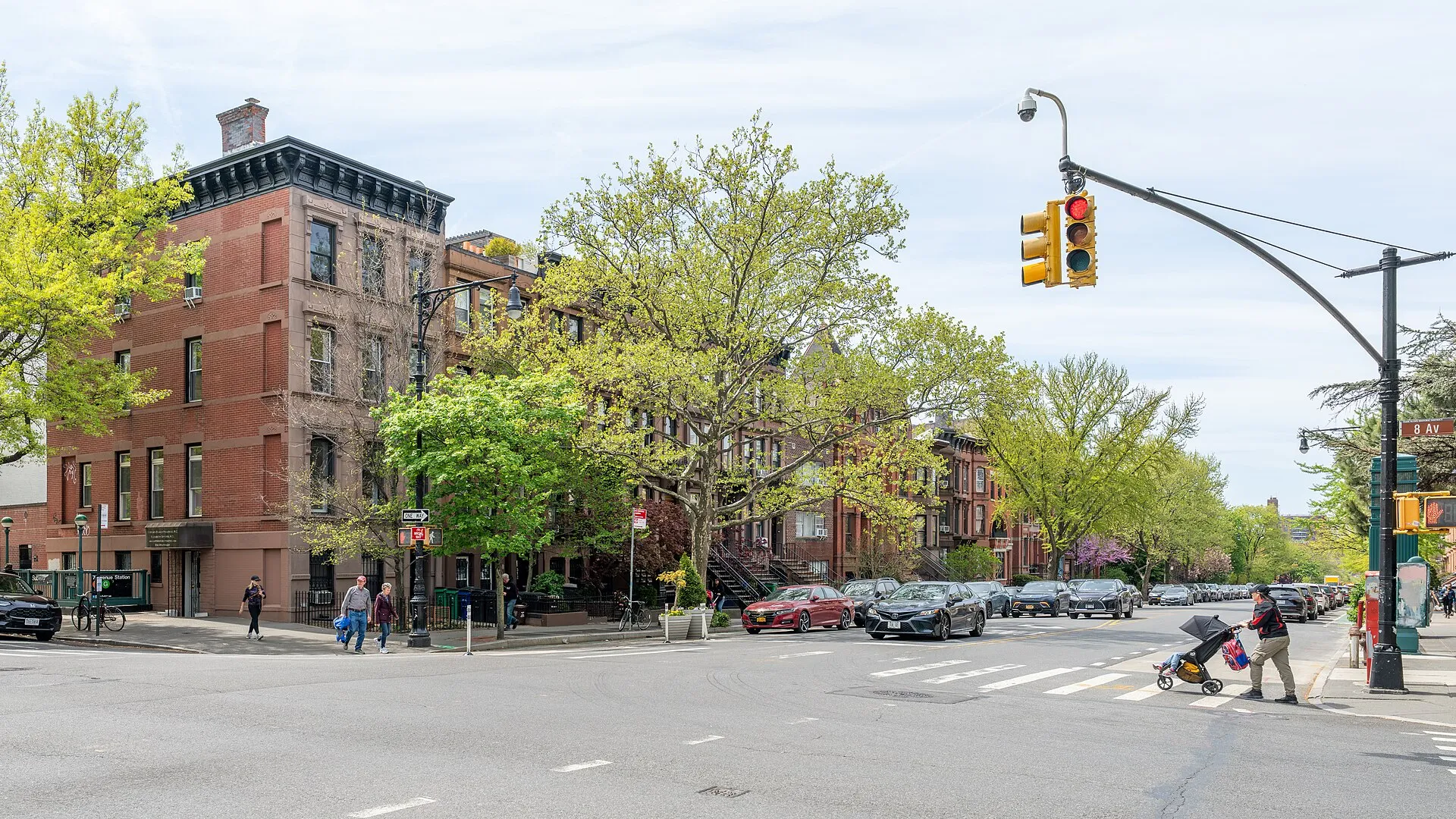
Park Slope contains one of the largest and most visually cohesive landmarked zones in the United States. The Park Slope Historic District, designated in 1973 and expanded in 2016, encompasses over 2,500 historic buildings exhibiting late 19th- and early 20th-century Romanesque Revival, Neo-Grec, Queen Anne, Italianate, and French Second Empire typologies. Construction features rough-hewn brownstone and smooth limestone facades, deep cornice lines, angular bay windows, deeply recessed entryways, and L-shaped stoops with cast-iron railings. Prospect Park West features grand gilded-age mansions and mid-rise pre-war apartment buildings.
Contrasting the historic core, the Fourth Avenue corridor drives vertical new development. Notable projects include 575 4th Avenue Condominium (an 11-story, 70-unit building designed by Fischer Makooi with Meshberg Group interiors), Six Garfield at 269 4th Avenue (a 12-story, 33-unit luxury building designed by DXA Studio), Novo at 343 4th Avenue (a 12-story, 113-unit condominium), and Kay's Place at 487 4th Avenue (an 11-story mixed-use building designed by Aufgang Architects).
Dining & Culture
Fifth and Seventh Avenues serve as the primary commercial arteries, hosting destination dining venues within restored 19th-century storefronts. Al di la Trattoria has anchored Fifth Avenue since 1998 with its rustic Venetian-influenced menu and historic tin-ceilinged dining room. Fausto on Flatbush Avenue offers elevated modern Italian cuisine, while culinary variety continues with inventive Korean dishes at Haenyeo and refined Mexican plates at Fonda. Artisanal purveyors like Pasta Louise operate alongside independent bookstores and historic corner bodegas, sustaining a maker-driven retail economy.